Friday, September 30, 2016

Firewall Modes on Cisco ASA

Which are the two modes of Cisco ASA firewall
Routed and Transparent

What is the default mode of Cisco ASA
Routed

Routed Mode

How ASA acts in routed mode
As a router hop in the network

What are the features of routed mode
  • Support many interfaces
  • Each interface requires an IP address
  • Each interface belong to different subnet


Can we share interfaces between contexts
Yes

Which routing protocol supported in single context routed mode
OSPF, EIGRP and RIP

Which routing protocol supported in multiple context routed mode
Static routes only

Transparent firewall

Does transparent firewall acts a router hop in the network
No

What is transparent firewall
Layer 2 firewall

What are the other names for transparent firewall
Bump in the wire or stealth firewall

Does transparent firewall seen as a router hop in tht network
No

What are the features of transparent firewall
  • Connect same network on inside and outside interface
  • No need to configure IP address on interfaces
  • Both interface belong to same subnet


What is the benefit of using transparent firewall
Easy to deploy into an existing network


Flash Cards

EIGRP Operations


Which tables supported in EIGRP router
Support three tables
Neighbor table
Topology table
Routing table
EIGRP operation is based on these three tables

What information contained neighbor table
Set of neighbors with which EIGRP router has established adjacencies

What is the command to display neighbor table
Show ip eigrp neighbor

How neighbor routers are characterized
By their primary IP address and the directly connected interface that leads to them

What does topology table contain
All destination routes advertised by the neighbor routers
Each entry in topology table associated with a list of neighbor that have advertised the destination
For each neighbor, an advertised metric is recorded in the topology table

What is the command to display topology table
Show ip eigrp topology

What is routing table
Table has best routes to destination

What is the command to display routing table
Show ip route eigrp


1) The route with the best metric to the destination is called the ______

Where successor or best path is placed
Routing table
Advertised to neighbor router


Neighbor process


R1 sends hello packets on all EIGRP enabled interfaces
R2 receive the hello packet on its interface
  R2 reply with update packets
  Update packets contain all routes from R2 routing table
  Routes learned via split horizon not included into update
R2 send update packet to R1
  Neighbor relationship is not established until R2 sends a hello packet to R1
Update packet from R2 has initialization bit set
  Indicate the initialization process
Update packet include routes and metric for each destination
Both R1 and R2 have exchanged hello packets
  Neighbor adjacency is established
R1 replies to R2 with ACK packet
  Indicate that update packet is received
R1 assimilates all the update packet in its topology table
 Topology table include all the destination that are advertised by neighbor router
R1 send update packet to R2
R2 send an ACK packet to R1
R1 and R2 successfully exchange update packets
R1 and R2 will update their routing tables with successor routes from topology table


1)  Successor

More blogs on networkcards.weebly.com

EIGRP Features


Which features are similar between IGRP and EIGRP
High speed convergence
Partial updates
Support multiple network layer protocols

What is the first step in configuring EIGRP
Establish EIGRP neighbor relationship

Which is the older version of EIGRP
IGRP


What are the features of EIGRP that distinguish from other routing protocols
Fast convergence
Support variable length subnet masking VLSM
Partial updates
Support multiple network layer protocols

1) EIGRP is a _____ protocol

2) EIGRP combines the features of ____ and ______ routing protocols

3) EIGRP is a ______ routing protocol

What are the benefits of using EIGRP
Easy to configure
Adaptable to wide variety of network topologies
Dynamic neighbor discovery
Provide rapid convergence
Loop free topology


4) EIGRP is an _____ IGRP

Which algorithm used by EIGRP to achieve rapid convergence
DUAL diffusing update algorithm

5) A router running EIGRP stores its neighbors’______

What happen if there is no appropriate route in the local routing table and no appropriate backup in the topology table
EIGRP send queries to its neighbors to discover an alternative route

6) EIGRP sends_____ updates

Does EIGRP router send periodic updates
No

When updates are send by EIGRP router
When the path or the metric for a route change
Update contain information about only the changed link rather the entire routing table

7) EIGRP consumes significantly ______ than IGRP

8) EIGRP supports IP Version 4 (IPv4) and IP Version 6 (IPv6) using _______

9) For communication between routers, EIGRP uses ____ and _____ rather than broadcast

Which is the multicast address used by EIGRP
IPv4 is 224.0.0.10,
IPv6 is FF00::A


10) EIGRP is a ____ routing protocol

Which information is advertised for each destination
Subnet mask
Enables EIGRP to support discontinuous sub networks and VLSM

11) EIGRP represents metric values in a ______

12) EIGRP supports ______ load balancing


Why EIGRP uses RTP or reliable transfer protocol
For reliable exchange of information

What is the protocol number of EIGRP
88

What is reliable transport protocol
Acknowledgment require from the receiving router
Packet should be delivered in order
Include sequence number in the packet for ordered delivery

Which packets are delivered reliably or un-reliably
Updates require reliable delivery
Queries and Replies require reliable delivery
Hello packets does not require reliable delivery
Acknowledgment ACKs are hello packet with no data not require reliable delivery


1) Cisco proprietary
2) Link state , distance vector
3) Distance vector
4) Enhanced
5)  Routing tables
6)  Partial triggered
7) Less bandwidth
8) Protocol-Dependent Modules
9) Multicast, Unicast
10) Classless
11) 32 bit format
12) Unequal Metric


Thursday, September 29, 2016

Multicast Addresses


IP multicast address Description
224.0.0.4 Distance Vector Multicast Routing Protocol (DVMRP) 
224.0.0.5 OSPF
224.0.0.6 OSPF DR 
224.0.0.9 The Routing Information Protocol (RIP) Version 2
224.0.0.10 The Enhanced Interior Gateway Routing Protocol (EIGRP)
224.0.0.13 Protocol Independent Multicast (PIM) Version 2
224.0.0.18 Virtual Router Redundancy Protocol (VRRP)
224.0.0.19–21 IS-IS over IP
224.0.0.22 Internet Group Management Protocol (IGMP) version 3[2]
224.0.0.102 Hot Standby Router Protocol version 2 (HSRPv2) / Gateway Load Balancing Protocol (GLBP)
224.0.0.107 Precision Time Protocol (PTP) version 2
224.0.0.251 Multicast DNS (mDNS) address
224.0.0.252 Link-local Multicast Name Resolution (LLMNR) address
224.0.1.41 H.323 Gatekeeper discovery address
239.255.255.250 Simple Service Discovery Protocol address
239.255.255.253 Service Location Protocol version 2 address


Types of Traffic


1) Routing protocols use different ______to control how routing information is exchanged

Which are the different types of traffic
Unicast
Multicast
Anycast
Broadcast
  
What is unicast traffic
One to one context
Exchanged only between one sender and one receiver


What is multicast traffic
Identify a group of interfaces
Traffic sent to multiple destinations at the same time
Interface may belong to any number of multicast group


What is the reserved address space for multicast
IPV4 224.0.0.0–239.255.255.255
IPV6 has prefix FF00::/8
  
What is anycast
Network addressing and routing methodology
Traffic send from a single sender to topologically nearest node in a group
All receivers are identified by same destination address


What is broadcast traffic
Traffic send to all devices in the subnet
Traffic send by one sender to all connected receivers
Local broadcast address 255.255.255.255
Used for communicating with all devices in the local network


2) IPv6 does not use a ____, but uses ___ addresses

3) Any cast addressing uses a ___ association
4) Broadcast addressing uses a ____ association
5) Multicast addressing uses a ____ association
6) Unicast addressing uses a ___ association


Answers Below


1) traffic types
2) broadcast address, multicast
3) one-to-nearest
4) one-to-many
5) one-to-unique many

6) one-to-one


Types of Routing Protocols


Which are the different types of routing protocol
Distance Vector
Link state
Path vector

How routing protocols are classified
Based on kind information about network reachability is exchanged between the routers

Distance Vector protocol
What is distance vector protocol
Determines direction (vector) and distance (link cost or number of hops) to any links in the network

How distance vector uses router
As a signpost

What does signpost indicates
Direction ad distance
Give no direction about the type of path

Which information routers know about remote network in distance vector protocol
Distance or metric to reach the network 
Path or interface to reach there

1) Distance vector routing protocols do not have an ____ of the network topology

How updates are shared in distance vector protocol
RIPV1 and IGRP send update periodically
EIGRP and RIPV2 uses triggered update

Link State protocols
Which algorithm use by link state protocol
Shortest Path First

2) A link-state routing protocol is like having a _____ of the network topology

How map is used by link state protocols
Determine the best path

3) All link-state routers have an _____ of the network

Which information used by link state protocol to create topology map and to select best path to all destination network
Link state information

Which are the types of link state protocol
OSPF and IS-IS


Path Vector Protocol
What information is exchanged by path vector routers
Information about the existence of destination networks
Exchanges the path on how to reach the destination

4) _______ is used to determine the best paths and to prevent routing loops

5) Path vector protocols do not have an ___of the network topology

6) Path vector protocols use ____ indicating direction and distance

Which is the type of path vector protocol

BGP


1) actual map
2) complete map
3) identical “map”
4) Path information
5) abstract 
6) signposts


FD, RD,FS in EIGRP

What is feasible distance
Best metric along a path to a destination network, including the metric to the neighbor advertising that path

What is reported distance
Reported distance is the total metric along a path to a destination network as advertised by an upstream neighbor

What is feasible successor
A feasible successor is a path whose reported distance is less than the feasible distance (current best path)
 
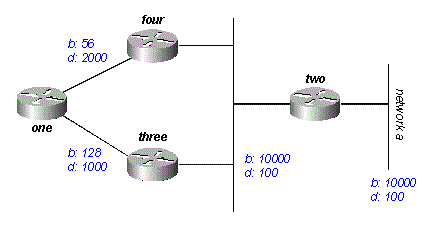
How many routes are available for router One to reach Network A
Two routes
Through router 4 and through three

What are the cost to reach network a from router four and three
The route through Router Four has a cost of 46277376
The route through Router Three has a cost of 20307200

What is the reported distance from router four and three
Reported distance of 307200
Metric to get to Network A from Router Four

Metric to get to Network A from Router Three
Reported distance of 307200


Which path would be chosen by router one to reach network A
Path through router three
Path through router three is feasible distance


Does router one considered path through router four as feasible successor
Yes
Reported distance to network A through Router Four is less than the feasible distance

What happen when a link between router one and router three goes down
Router one has a feasible successor through Router Four
Uses feasible successor as new feasible distance
Network converges


We have following network

How many routes are available from router one to reach network A
Two routes
One through router four with a metric of 20307200
Another through router two with a metric of  46789376

What would be the feasible distance to reach network A from router one
Path through router four

Does path through router two qualifies as the feasible successor
Reported distance from Router Two is 46277376, which is higher than the feasible distance - so this path is not a feasible successor

How many path would be seen in the topology table of router one using show ip eigrp topology command
Only path through router four

Which command can we use to see path that are not feasible successor
show ip eigrp topology all-links

What happen if a link between router one and router four goes down
Router one has only one path to reach network a
Send queries to each of its neighbors
Send query to router two
Router two has route to network A
Router two respond to query
Router four accept the path through router two to network A


Wednesday, September 28, 2016

EIGRP Metric

 
What is the default metric used by eigrp router
Minimum bandwidth on the path and the total delay

How bandwidth and delay are determined
Determined from values configured on the interfaces of router in the path to the destination network
  
How many paths router one has to reach network A
It has two path
Through router four and through router three

What is the bandwidth and delay configured through router four
Minimum bandwidth 56
Total delay 2000

What is the minimum bandwidth and delay configured through router three
Minimum bandwidth 128
Total delay 1000

Which path will be chosen by router one
Path with lowest metric

Which formula used by eigrp to scale bandwidth
Bandwidth =  (10000000/bandwidth(i)) * 256
Where bandwidth(i) least bandwidth to destination and represented in kilobits

Which formula used by eigrp to scale delay
Delay = delay(i) * 256
Where delay(i) is the sum of the delays configured on the interfaces to destination and represented in ten microseconds

Internetworktuts
How delay are represented in show ip eigrp topology or show interface command
In microseconds
We need divide delay by 10 before we use it on the formula

Which formula used by eigrp to scale total metric to destination network
Metric = ([K1 * bandwidth + (K2 * bandwidth) / (256 - load) + K3 * delay] * [K5 / (reliability + K4)]) * 256

What is the importance of using k value
Must be used carefully
Mismatch k values prevent neighbor relationship from being built and will not converge network

What would be the formula if k5 = 0
Metric = ([k1 * bandwidth + (k2 * bandwidth)/(256 - load) + k3 * delay]) * 256.

What is the default k values
The default values for K are:
K1 = 1
K2 = 0
K3 = 1
K4 = 0
K5 = 0

What would be the formula with default k values
Metric = bandwidth + delay

Does cisco routers uses floating point number
No
  
In the above network, what would be the total cost through router four
Minimum bandwidth = 56k
Total delay = 100 + 100 + 2000 = 2200
[(10000000/56) + 2200] x 256 = (178571 + 2200) x 256 = 180771 x 256 = 46277376 

What would be the total cost through router three
Minimum bandwidth = 128k
Total delay = 100 + 100 + 1000 = 1200
Bandwidth = [(10000000/128) + 1200] x 256 = (78125 + 1200) x 256 = 79325 x 256 = 20307200 
Metric = 20307200  + 1200
  
Which path will be chosen by router one to reach network A
Router one will choose path through router three
Path through router three has lowest metric


Different Types of Router Memory


Which are the different types of Router memory
ROM
Flash Memory
RAM
NVRAM


What is ROM
Available on router's processor board
Store initial bootstraps software
Maintain instruction for POST diagnostics

What is flash memory
Contain full operating system image
Electronically erasable and re-programmable memory
Allow us to upgrade the IOS without removing flash memory from system
Retain content when router is powered down or restarted


What is RAM
Loses information when router is shutdown or restarted
Hold running configuration
 Such as arp cache, routing table
Temporary memory
Perform packet buffering

What is NVRAM
Store startup configuration file
Fast memory
Retain content when the router is restarted

IOS reads startup config when the route boots up

Tuesday, September 27, 2016

OSPF Versus RIP


Which is the type of OSPF protocol
Interior gateway protocol

How OSPF is used
To distribute routing information within single AS

Which technology used by OSPF
Link state technology

Which new concept has been introduced in OSPF
  • Authentication of routing updates
  • Variable length Subnet Mask VLSM
  • Route summarization


OSPF versus RIP


What is the maximum hop counts supported by RIP
15

Does RIP support VLSM
No

How RIP send updates
Periodic broadcast of full routing table
Consume a large amount of bandwidth


1) RIP converges _____ than OSPF

Which concept RIP does not support
Network delay and lick costs

How routing decision done by RIP
Based on hop counts

Which path is preferred in RIP?
Path with a lowest hop count to a destination

What is the drawback of selecting path based on hop count
Longer path having better bandwidth and less delay not preferred

2) RIP networks are ___ networks

Does RIP network support areas or boundaries
No

Which enhancement were introduced in RIP version 2
VLSM , authentication and multicast routing updates

What are limitation with RIP version 2
Routing decision on hop counts
Slow convergence


Is there any limitation of hop count on OSPF network
No

How OSPF send link state updates
Using multicast address

When OSPF send updates
In case routing changes

Does OSPF routers send periodic updates?
no


3)OSPF has better ____ than RIP


How OSPF network is design
Logical divided into areas
Hierarchical design

What is the advantage of logically dividing network into areas
Limits link state updates


What are the various features of OSPF
  • Routing authentication based on various method
  • Provide better load balancing
  • Transfer and tagging of external routes injected in to an Autonomous System
  • Keep track of external routes injected by protocol like BGP 


Answer
1) Slower
2) Flat
3) Convergence


Join the Facebook Page

VTP Modes


Which are the three VTP modes
Server
Client
Transparent


What functions can be performed in server mode
Create, modify and delete VLANs
Specify configurations parameter such as VTP version and VTP pruning for the entire VTP domain
Advertises VLAN configuration to other network devices in same VTP domain
Synchronize VLAN configuration with other network devices

1) VTP ____ is the default mode


What are functions available on client mode
Behave same as server mode
Cannot create, change or delete VLANs

What is transparent mode
Do not participate in VTP
Does not advertise its own VLAN configuration
Does not synchronize its VLAN based on received advertisement
Forward VTP advertisement received on their trunk link

Answer 
1) Server


VTP Domain


what is VTP 
layer 2 messaging protocol

why we use VTP
We use VTP to maintain VLAN configuration consistency

How we maintain vlan configuration consistency
By managing the addition, deletion and renaming of vlans within a VTP domain

what is VTP domain
Made up of one or more network devices 
All devices in same VTP domain share same VTP domain name

what are the benefits of using VTP
  • Minimizes misconfiguration
  • Configuration consistencies
  • Prevent number of problems such as duplicate vlan names, incorrect vlan type specification and security violations


VTP domain


What is VTP domain
Made up of one or more interconnected network devices
All devices share same VTP domain name

1) A network device can be configured to be in ________ domain


What is the default VTP mode
Server mode

What is the default domain name
Set to null 

When VTP domain name on a switch changes
Receives an advertisement for a domain over a trunk link
We manually configure domain name


what happen when switch receives a VTP advertisment over a trunk link
Inherits management domain name and VTP configuration revision number

what happen when a change is made on the VTP server switch
Change is propagated to all network devices in the VTP domain

2) VTP advertisement are transmitted out all _______ and ________trunk connections


Answer 

1) Only One VTP
2) inter-switch link,  IEEE 802.1Q